5.3 Being critical

Were you surprised by how difficult it was to find accurate information in the last task? Hopefully you’ve had a chance to discuss the problems inherent in finding relevant and reliable data on the internet.
You should now be thinking more deeply about the kinds of questions we need to be asking whenever we use Google or another search engine to access information. Many different individual and organisations publish their information, ideas and data for multiple purposes, and with many different agendas. It’s your job to interrogate every source that you use to evaluate its reliability, and to ensure that you’re aware of any potential bias (intentional or otherwise).
Here are some simple questions to ask:
- Who published/uploaded this information, and why?
- Who is their intended audience?
- Do they have any credentials to back up their authority on a subject?
- Do they acknowledge the sources they used to create the information or form their opinions?
When teaching you how to evaluate sources of information, ideas and data (whether academic or not), we’ll often recommend that you run through the ‘who, what, why, when, where and how’ questions. It comes down to never taking anything at face value - in other words, becoming a ‘critical reader’. This is your first step in achieving the highest grades in your academic work!
As you become more confident with using our library resources, both on campus and online, you’ll realise that the most valuable texts and databases to support your academic work are not found using Google, but through proficient use of library searches.
Being critical
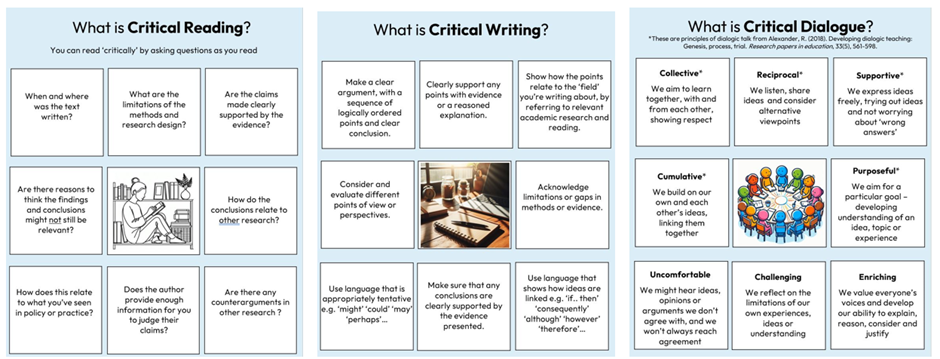
You won't just need to read critically, but also to demonstrate critical writing and critical discussion. 'Critical' in this context isn't the same as 'criticising' in the everyday meaning of the word. In academic work, it means:
- Exploring and presenting the evidence-base of any claims
- Creating reasoned arguments that clearly link your views of evidence
- Showing awareness of gaps in knowledge - what we don't know yet
- Considering different perspectives
- Acknowledging the complexity of a topic.
How you write or talk in academic work will vary slightly according to the discipline you're studying, but this idea of 'criticality' will underpin everything.