

10.2 Classics and Ancient History
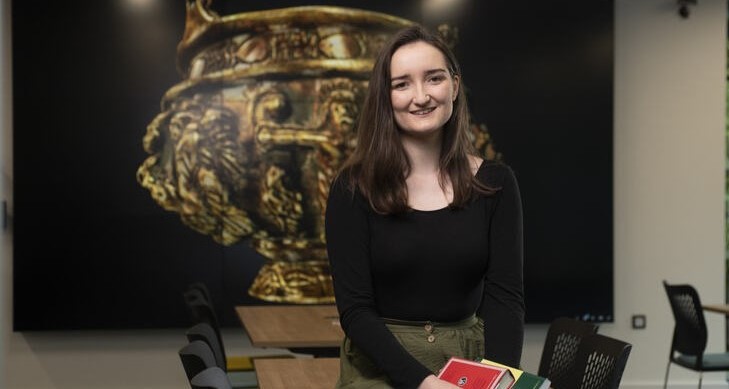
A very warm welcome to Classics and Ancient History at the University of Exeter and congratulations on gaining a place to study here! You are joining a friendly and lively discipline and we look forward to getting to know you and welcoming you into our community.
We are a discipline that teaches several Single Honours degree programmes, including BA Ancient History, BA Classical Studies, and BA Classics, as well as a number of Combined Honours programmes taught jointly with Archaeology, English, History, Modern Languages, Philosophy, and Theology. We also teach students on Flexible Combined Honours (FCH) degree programmes with a Classics and Ancient History component.
We are part of a larger Department of Classics, Ancient History, Religion and Theology (CAHRT for short), which is itself part of the Faculty of Humanities, Arts and Social Sciences (HASS).
As a relatively small discipline and you will soon get to know us, especially those staff who will be teaching you. In the meantime, you can find out a bit more about us and our specialisms through our staff profiles.
Key contacts
You will each be assigned a personal tutor whom you will meet as part of your academic induction in Welcome Week. This person will be your first port of call for any questions you might have. Other key contacts include:
- Director of Education and Student Experience for CAHRT: Dr David Leith
- Senior Tutor for Classics and Ancient History: Professor Sharon Marshall
- Head of Department for CAHRT: Professor Rebecca Langlands
Preparing for your degree
We don’t expect you to complete any preparatory work before you get here, but if you’re keen to acclimatise yourself to your course and do a little reading before term starts, we’ve put together suggested reading material to whet your appetite for things to come. You are not expected to read all of these works – just pick and choose the titles that appeal most. You might want to start with some Greek and Roman literature in translation, such as:
- Catullus, The Complete Poems (translated by Guy Lee, Oxford World’s Classics).
- Herodotus, The Histories (translated by Robin Waterfield, Oxford World’s Classics).
- Homer, The Odyssey (translated by Emily Wilson, Norton Critical Editions).
- Plato, The Symposium (translated by Christopher Gill, Penguin Classics).
- Sophocles, Oedipus the King and Other Tragedies (translated by Oliver Taplin, Oxford World’s Classics).
- Suetonius, Lives of the Caesars (translated by Catharine Edwards, Oxford World’s Classics).
Alternatively, you might dip into some of these accessible introductions to different aspects of the ancient world:
- Armand d’Angour, Socrates in Love (Bloomsbury).
- Mary Beard, SPQR: A History of Ancient Rome (Profile).
- Ray Laurence, Roman Archaeology for Ancient Historians (Routledge).
- Helen Morales, Antigone Rising: The Subversive Power of the Ancient Myths (Headline).
- Sarah Pomeroy, Goddesses, Whores, Wives and Slaves: Women in Classical Antiquity (Bodley Head)
- Ronald Syme, The Roman Revolution (Oxford University Press).
Language learning
Lots of you will be taking a language module as part of your degree, especially if you are on a Single Honours programme. We offer both Latin and Greek at five different levels and it is important that you choose the right level according to your prior experience, using the language ladder below as a guide:
| Prior experience of Latin or Ancient Greek | Level |
| None | Classical Language and Texts: Latin I (A) and (B) or Classical Language and Texts: Greek I (A) and (B) |
|
GCSE or equivalent
|
Classical Language and Texts: Latin II or Classical Language and Texts: Greek II |
| A Level or equivalent | Classical Language and Texts: Latin III or Classical Language and Texts: Greek III |
If your prior experience does not fit into any of the above categories and you are unsure of the appropriate level to select, please email Classics@exeter.ac.uk for advice. If you are feeling at all anxious about language learning, rest assured that you will receive lots of support from both the academic staff who will be teaching you and your fellow students through our peer-mentoring scheme.
Our community
We would also encourage you to look out for the Classics Society advertising their events in Welcome Week and throughout the year. They are a friendly student subject society who run social events and other activities including our peer-mentoring scheme for the ancient languages, intramural sports teams, an annual Classics play, and a summer trip abroad.
Activity: Introduce yourself!
In the meantime, we would love it if you could start getting to know one another by posting a brief introduction in the Forum below, telling us who you are, what programme you are on, and what you are most looking forward to about starting your degree with us.
To post, simply click 'REPLY.'
Please be aware that any comments and contributions in this forum are open to the general public and NOT just other students in the cohort.
Once you have finished reading about your department(s), you can skip to end of this section rather than clicking next and reading through all department pages.